A Potted History of Ashwood Nurseries

In 1967 Joseph and Hilda Massey acquired Ashwood Nurseries from Harry and Dora Beach. Their son John, aged 18, was still at school while Tony Cartwright at 15 years old was already working there part-time: after school, at weekends and during his school holidays.
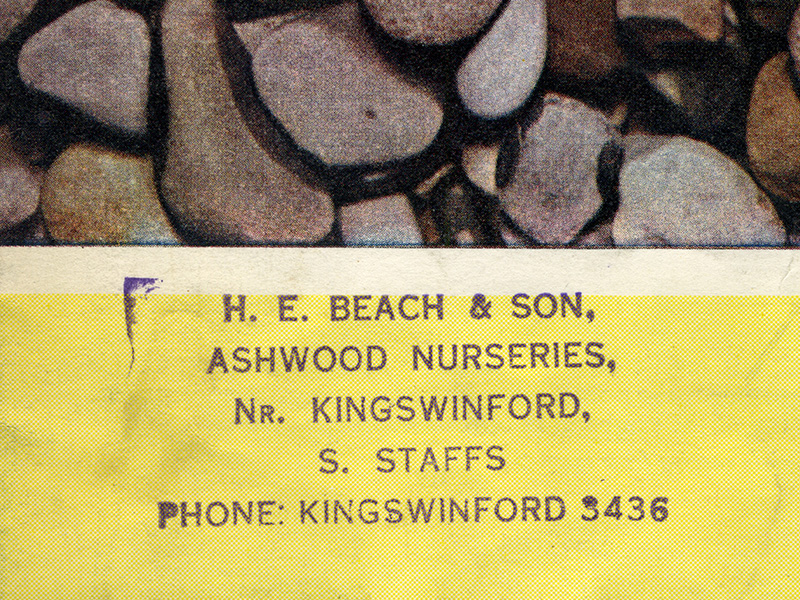
Up to this point, Ashwood (trading as H.E. Beach and sons) was a small nursery selling a limited range of plants and aquatics but it had become very neglected and run down as Mr. Beach’s health started to fail.
John recalls: “the nursery was dilapidated, with bantams and ducks scratching around, and a line of washing hanging in a greenhouse”
Mr. and Mrs. Beach lived in a crumbling wooden bungalow (at the rear of the site of the current garden shop). Adjacent to this was a tiny shop with a small office attached and an open ‘packing shed’ on the front near the road.
Tony says: “The packing shed was used to pack hardy plants such as trees, roses and shrubs which were all sold ‘bare-root’ from October to March. A small range of containerised plants was also available grown in used tin cans supplied by the local butcher”
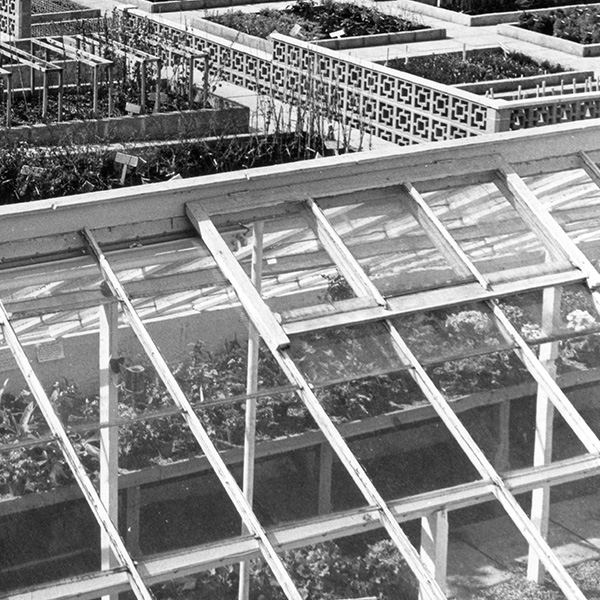
There was one partially sunken greenhouse for tender plants, heated by an antequated boiler. Here geraniums and fuchsias were sold together with cinerarias, gloxinias, Primula obconica, Primula malacoides and Maidenhair ferns (supplied by Elliot and Jackson of Kidderminster).
A second fully sunken cold house with a flat glass roof was used to grow bulbs in pots. Mr. and Mrs. Beach also sold bedding plants grown by Kidderminster nurseryman Horace Baulk and his son Philip. Another supplier was Blackhill Nurseries, Swindon (Howard & Geoff Wenlock) and the second generation of this family still supplies Ashwood today.
In 1968, John Massey took over the day-to-day running of the nursery and is still very much involved with the business in our 50th Anniversary year. Tony Cartwright and Stella Gilson also started work full-time in 1968, followed by Barbara Pomeroy in 1969. Tony, Stella and Barbara are all still working at Ashwood, with an amazing 146 years of service between them.
At that time, John’s interests were hardy plants of every kind but he soon developed a particular passion for alpines, heathers and dwarf conifers.
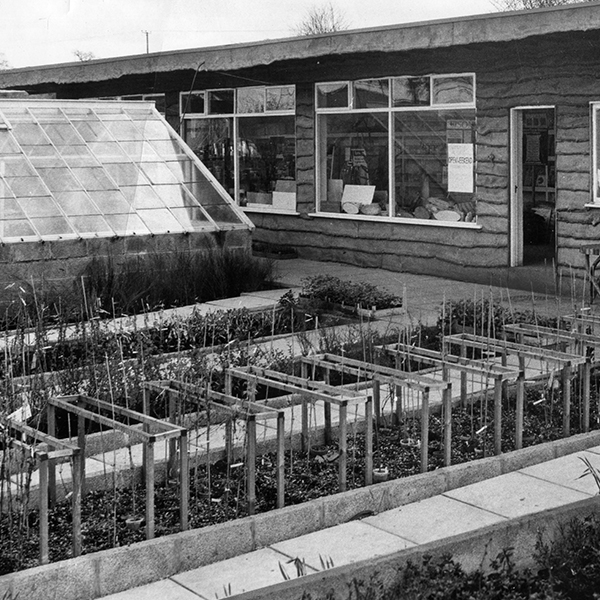
John was keen to learn and many local nurserymen were influential including Percy Picton of Old Court Nurseries at Colwall, Geoff and Jean Gittins of Greenhill Nurseries, Wombourne, Claud Palmer of Richard Smith Nurseries, Worcester, Diana Palmer of Palmer’s Nurseries, Worcester and Joe Elliott of Broadwell Alpines in the Cotswolds.
John could also see the potential of the aquatics business and by June 1968 a new series of fibre-glass pools for fish sales had been constructed by Dutch Gardens of Wall Heath. Fish such as koi carp, shubunkins and goldfish were hugely popular: many were flown in from Bologna, Italy.
During 1968, work began on a new shop while a greenhouse (bought second-hand) was erected (on the site of the current shrub production house) and new sales beds were created.
In 1969, alpines and heathers were some of our best sellers. Alpines were grown in terracotta pots and plunged in sand: our main suppliers were Honor’s Nursery of Snowshill (delivered by train to Stourbridge Junction!). Joe Elliott and Teme Valley Nurseries (Tenbury Wells).
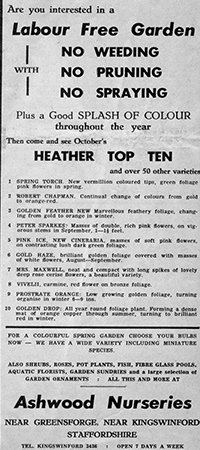
Heathers were bought in from local grower Roy Bodenham and our series of Heather Top Ten adverts (County Express) boosted heather sales and business in general (1600 heathers sold in less than 2 weeks).
Barbara recalls: “the four of us worked very long days, an early finish was 6pm, but in reality it was often between 7pm and 8pm during busy periods. Equal pay for women was unheard of then and in 1969 I earned £7.10 shillings a week… but the pay was unimportant because I loved what I was doing.”
Hardy plants were now being grown mainly in Hado polythene pots; we also used whalehide pots and hessian sacking. Many plants were still sold bare-root: roses, hedging and trees in particular. Johnny Malpass of BBN Composts, Wombourne supplied us with loam-based John Innes composts.
Stella remembers: “Bedding plants were grown in wooden trays of 60 plants and Paul Crample (price 2/6d) was everyone’s favourite geranium. Plant labels were mainly hand written or typed, catalogues were produced on a typewriter”
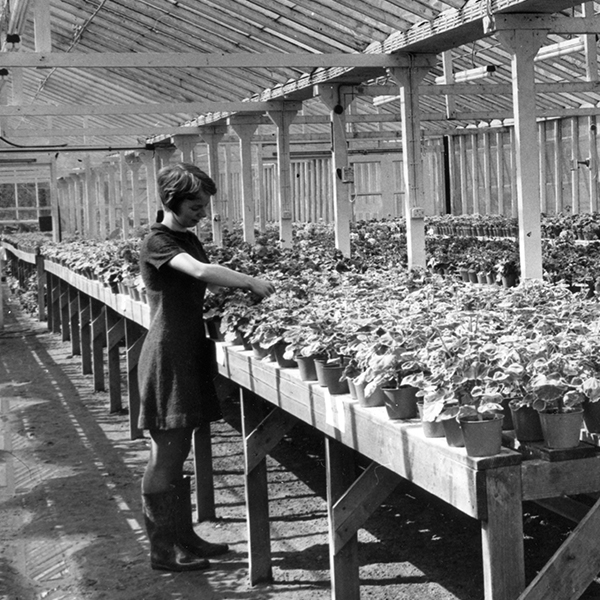
In autumn 1969, work began on a much larger aquatics section while landscape gardener Richard Amphlett started work on a rock garden, pool and Japanese garden.
A growing interest in gardening:
Greater prosperity in the 60’s, together with a building boom, resulted in a growing interest in gardening. Gardeners’ World on BBCTV had started in 1967 (does anyone remember the first presenter Ken Burras?). But it was Percy Thrower (who became the lead presenter in 1968) who was to have a huge influence on the popularity of gardening during this time.
Garden centres were springing up everywhere and, with a rise in car ownership, becoming increasingly popular visitor destinations, especially on Sundays when shopping centres were closed.
Originally posted March 2017, © Barbara Cartwright
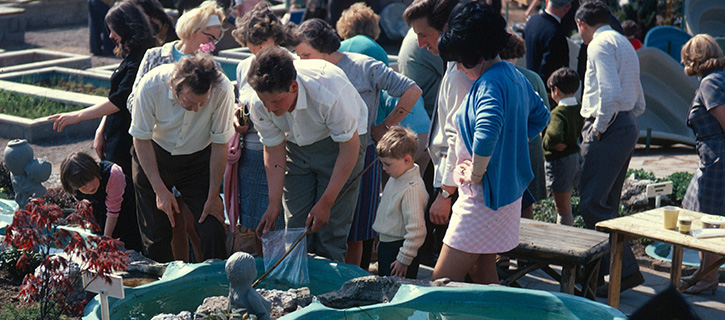
In 1970, Ashwood Nurseries was undergoing some big changes which were to transform it from the run down and dilapidated nursery that had been acquired by Joseph and Hilda Massey in 1967.
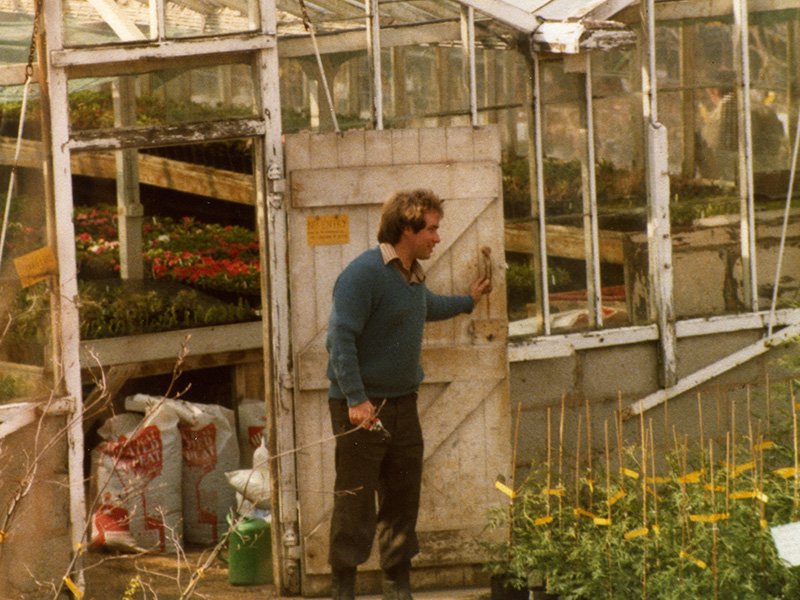
Their son John, 21, was responsible for the running of the nursery with the help of a very young staff of three: Tony Cartwright, Stella Gilson and Barbara Pomeroy (all still working at Ashwood with 146 years of service between them).
In 1970 the business was re-named Ashwood Nurseries and Aquatics. Joseph Massey designed the Ashwood Logo, two ash leaves enclosing the gentian (reflecting John’s passion for alpines) and the fish representing our aquatics business.

The plant sales area was completed along with a big new aquatics area. Heathers, alpines and conifers were our best sellers, as well as fibre-glass ponds and cold-water fish. Landscape gardener Richard Amphlett continued his work, begun in 1969, creating new rock gardens (using 30 tons of Westmorland stone) and a traditional Japanese garden.
1970 Open Weekend
The main focus in early 1970 was preparation for the Open Weekend on May 2nd and 3rd. The event was an overwhelming success with good publicity (including a pull out supplement in the Express and Star) and fine weather ensuring an amazing turnout.
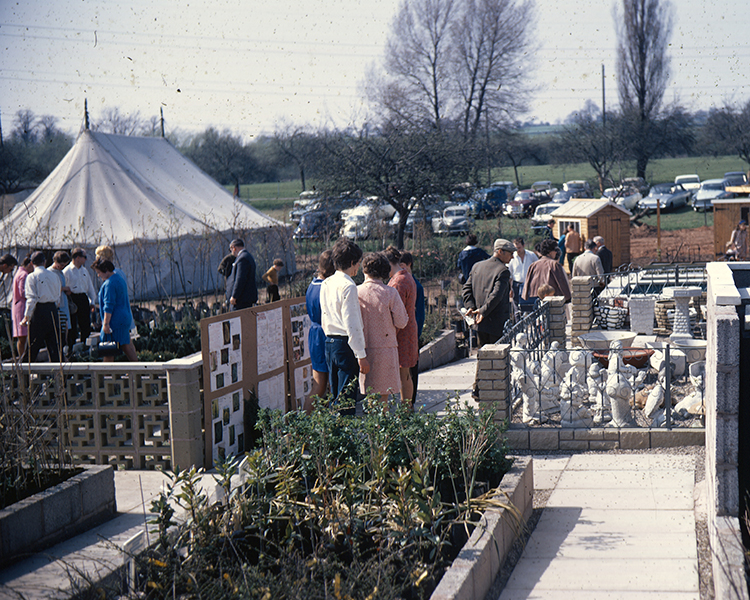
Many of our suppliers were represented including Fisons, PBI, Guys Tools, Grey Rose Products (wrought iron) and Bedford Stone Ornaments (all no longer in existence). A marquee was home to flower arranging demonstrations and competitions.
Family members and friends were recruited to help and the cash registers didn’t stop ringing (pounds, shillings and pence then, electronic tills and credit cards were unheard of).
Our car park was tiny at this time so our neighbours Alf and Barbara Shakespeare allowed us to use their field for the event. Even this extra car-parking was inadequate and, as a result, cars parked all along the lane, stretching as far as the Navigation Pub and along the Mile Flat in one direction and all the way back to the A449 Kidderminster Road.
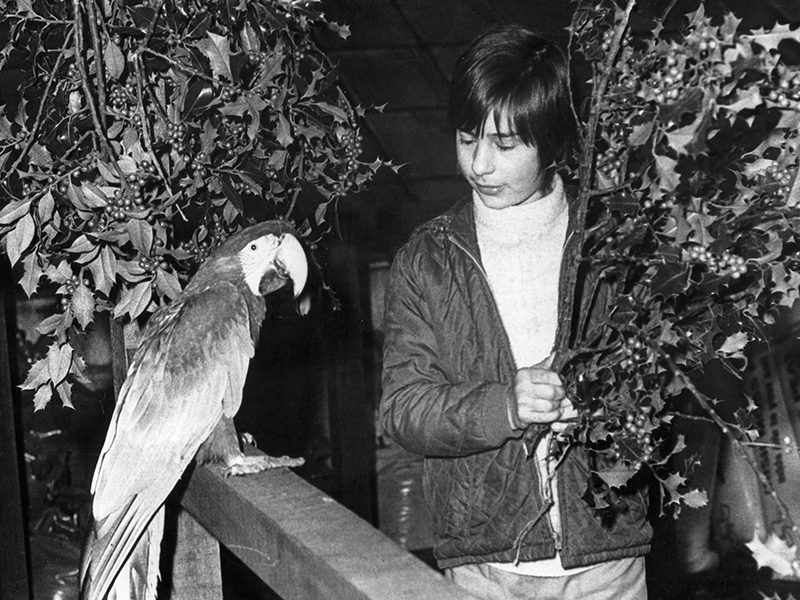
A welcome addition to the Ashwood family
In 1970 we welcomed Fang the macaw to the Ashwood family, a 21st Birthday gift to John from his sister Susan. At first, Fang had freedom to fly around the nursery but, as he started to wreak havoc in the shop and on the nursery we had to confine him to a large cage. He was a great character with a colourful vocabulary, and many customers remember him with much fondness.
New developments 1971-1975
The period 1971-1975 saw many new developments including (in 1971) the acquisition of land opposite The Garden Shop (£150) from farmer Edward Marsh for a new car park to accommodate 100 cars. The sunken greenhouse was replaced with a new wooden greenhouse for house plants, a twin-span aluminium greenhouse was built for the production of tender plants and a mist propagation unit for the production of conifers, Japanese Azaleas and small shrubs. Automatic watering was installed and the plunge beds for alpines were replaced with raised sales beds.
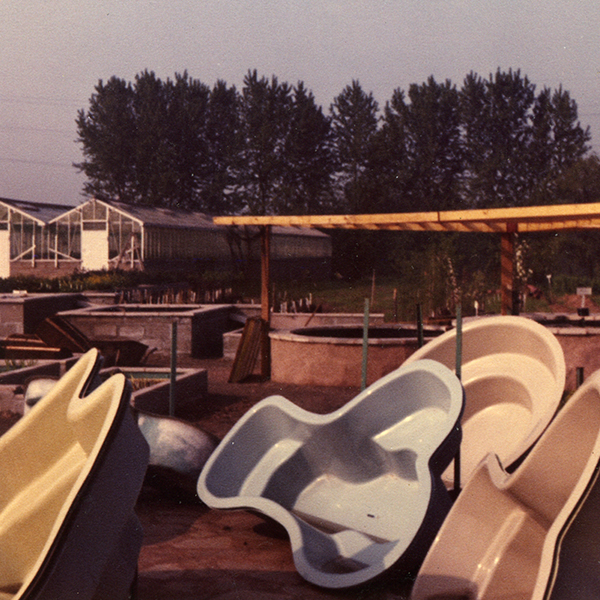
Our aquatics business continued to thrive as most keen gardeners aspired to own a fibre-glass pond stocked with a collection of cold-water fish and aquatic plants of every kind.
During this time, we also doubled our staff: these included the late and much loved Mary and Frank Chambers (often helped by their young daughter Jayne, now Ashwood’s florist), Philip Johnson (still with us!) and Fred Jennings (remembered with much affection). In 1973, we gained a full time secretary Ruth Burrows to bring order to the office (at 89 this year, she is still our Company Secretary).
More milestones
During this time there were various milestones that impacted on the business. Decimal Day on February 15th 1971 saw the decimalisation of the currency; on October 28th UK joined the Common Market and in 1973 VAT was introduced.
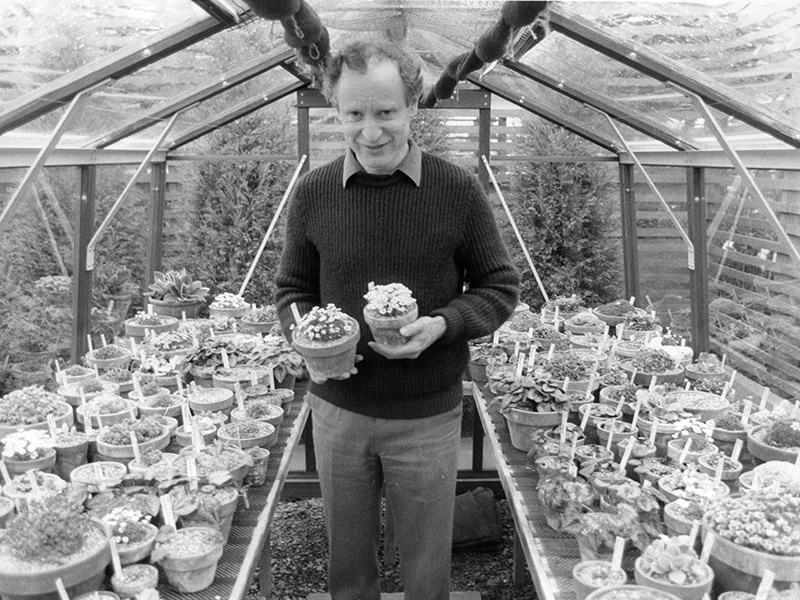
Another chapter begins…
In 1975, experienced grower Philip Baulk joined Ashwood and another chapter in Ashwood’s history began. The Ashwood speciality crops of lewisias, hellebores, hepaticas, Primula auricula and hardy cyclamen were only a twinkle in John’s eye but, under Philip’s expert guidance, their future development was to result in the Ashwood name becoming well known and respected in the UK and in other countries around the world.
Originally posted March 2017 © Barbara Cartwright