How to grow Primula auricula
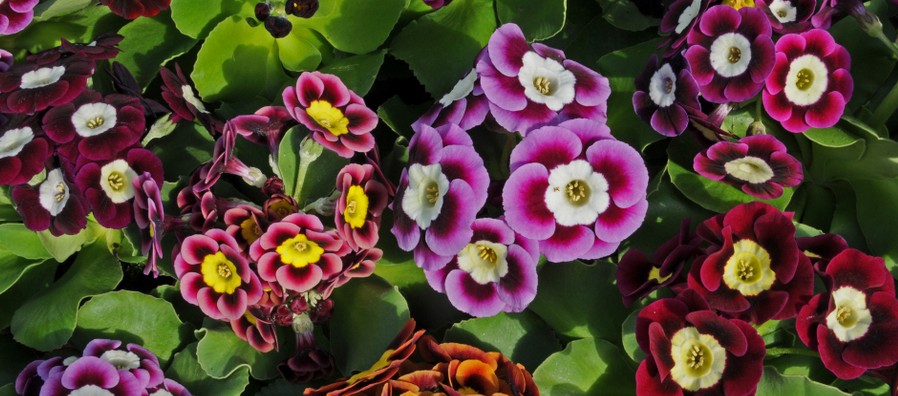
Primula auriculas, commonly referred to as just Auriculas, are hardy evergreen perennials. They have thick, leathery leaves that are sometimes dusted in a white powder known as ‘meal’. They produce jewel-like flowers on short stems in March and April.
Types of Auricula explained
At Ashwood Nurseries we sell four main types of Primula auricula: Border, Alpine, Double and Show.
Garden Auriculas
 Border auriculas are the original garden auricula, grown from seed and bred to produce free flowering plants in a wide variety of colours. Some border varieties are named, such as our ‘Ashwood Cavalier’. Doubles are another type of garden auricula, producing ruffled double flowers.
 Alpine varieties produce large flowers that have a bright gold or light centre. The flowers typically have a dark body, gradually changing to a light, bright edge of the petal. We have our own Ashwood Alpine Strain which comes in a variety of colours to choose from.
These varieties are the most common type of auricula you will see on the nursery. They are ideal for beginners and for use in the garden as they are easy to look after and flower readily. Most of these flowers are also scented.
Show Auriculas
Show auriculas have powdery ‘meal’ or ‘farina’, usually on the foliage and sometimes on the flowers. Meal can easily be washed off by heavy rain or careless watering, therefore show auriculas are best grown in a protected environment away from the elements. They are a little more difficult to grow, but very rewarding when they flower. We sell Selfs, Edges, Stripes and Fancies.
 Selfs are perhaps the most common type of show auricula. The centre of the flowers is gold and surrounded by a dense meal, creating a striking eye against the brightly coloured petals. Stripes are more unusual with the meal forming lines on each petal, and some varieties have multiple colours streaked through the petals as well.
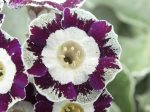 Edged auriculas have the strictest classification and therefore the hardest to come by. Edges have a mutation which turns the edges of the petals into leaf material, meaning they all have have edges of green, grey or white. The body of the flower must be black or very dark red, or it will not be classed as an edge. Fancies are edges that don’t conform to the strict criteria. They include all sorts of colour combination, all with the same distinct edge.
Growing Auriculas in an Alpine House
An alpine house is a well ventilated, unheated greenhouse. Usually they are kept shaded from late March until September. This protected environment is perfect for all Primula auriculas but especially the Show auriculas.
Traditionally auriculas are grown and displayed in ‘long toms’: long narrow terracotta pots. Normal terracotta and plastic pots are also suitable. When in flower the plants can be displayed on a traditional wooden auricula theatre. Auriculas are happy in most well-drained compost: we use a mix of John Innes Potting Compost No.2 with added perlite. Water your plants scarcely in autumn and winter, increasing in spring when flowers start to develop. Remove withered leaves regularly and re-pot in late spring/summer when necessary. Feed with simple tomato feed when flower buds appear to help promote flowering.
Growing Auriculas in the Garden
Garden auriculas such as Borders, Doubles and Alpines are most suited to garden cultivation. They thrive best in a well-drained, sheltered site in dappled shade. They can be planted directly in the garden in humus-rich, moist soil, or alternatively in a patio pot or alpine trough.
Make sure the compost or soil is well drained, adding extra grit to heavier soils. Place a layer of gravel mulch around plants in winter to help avoid rot. Garden varieties are hardy plants, so do not fleecing during winter months. Use well-rotted manure to enrich garden soil. For plants in containers, feed with simple tomato feed when flower buds appear to help promote flowering and repot when needed.